Understanding Compressor

Compressor is a motor-driven device located inside the outdoor condenser unit of an air-conditioning or heat-pump system. Compressor works like a bicycle pump: it draws in cool, low-pressure refrigerant vapor from the indoor evaporator coil, squeezes the vapor into a much smaller space. And pushes it out as hot, high-pressure gas. This high-pressure gas travels to the outdoor condenser coil, where it releases heat into the outside air and turns back into a liquid. The liquid refrigerant then returns indoors to absorb more heat, completing the cycle.
Related glossary terms: Condenser Coil, Evaporator Coil, Refrigerant.
Most residential compressors are hermetically sealed inside a welded steel shell. This shell protects the motor and refrigerant from dirt and moisture but also means the compressor can't be opened for field repairs. If the compressor fails, the entire outdoor unit usually must be replaced. Compressors come in different sizes, measured in tons of cooling capacity, to match the needs of homes ranging from small apartments to large houses.
How Compressor Works?
Compressor operation begins when the thermostat calls for cooling. An electrical relay closes, sending power to the compressor motor. The motor spins a set of internal pistons, scrolls. Or screws that physically compress the refrigerant vapor. As the vapor is squeezed, its temperature rises—often to 150 °F or higher—even though the outdoor air may be much cooler. This hot, high-pressure gas then flows through copper tubing to the outdoor condenser coil.
Inside the condenser coil, a fan blows outdoor air across the hot refrigerant tubing, removing heat from the refrigerant. As heat leaves, the refrigerant condenses back into a liquid. The liquid refrigerant then passes through a metering device, which lowers its pressure and temperature before it returns to the indoor evaporator coil. There, the cycle repeats: the refrigerant absorbs heat from indoor air, evaporates into a vapor. And travels back to the compressor for another round of compression.
- Piston compressors use back-and-forth motion to compress refrigerant, similar to a car engine.
- Scroll compressors use two spiral-shaped scrolls—one fixed, one orbiting, to trap and squeeze refrigerant vapor.
- Rotary compressors use a spinning roller inside a cylinder to compress refrigerant.
Why Compressor Matters?
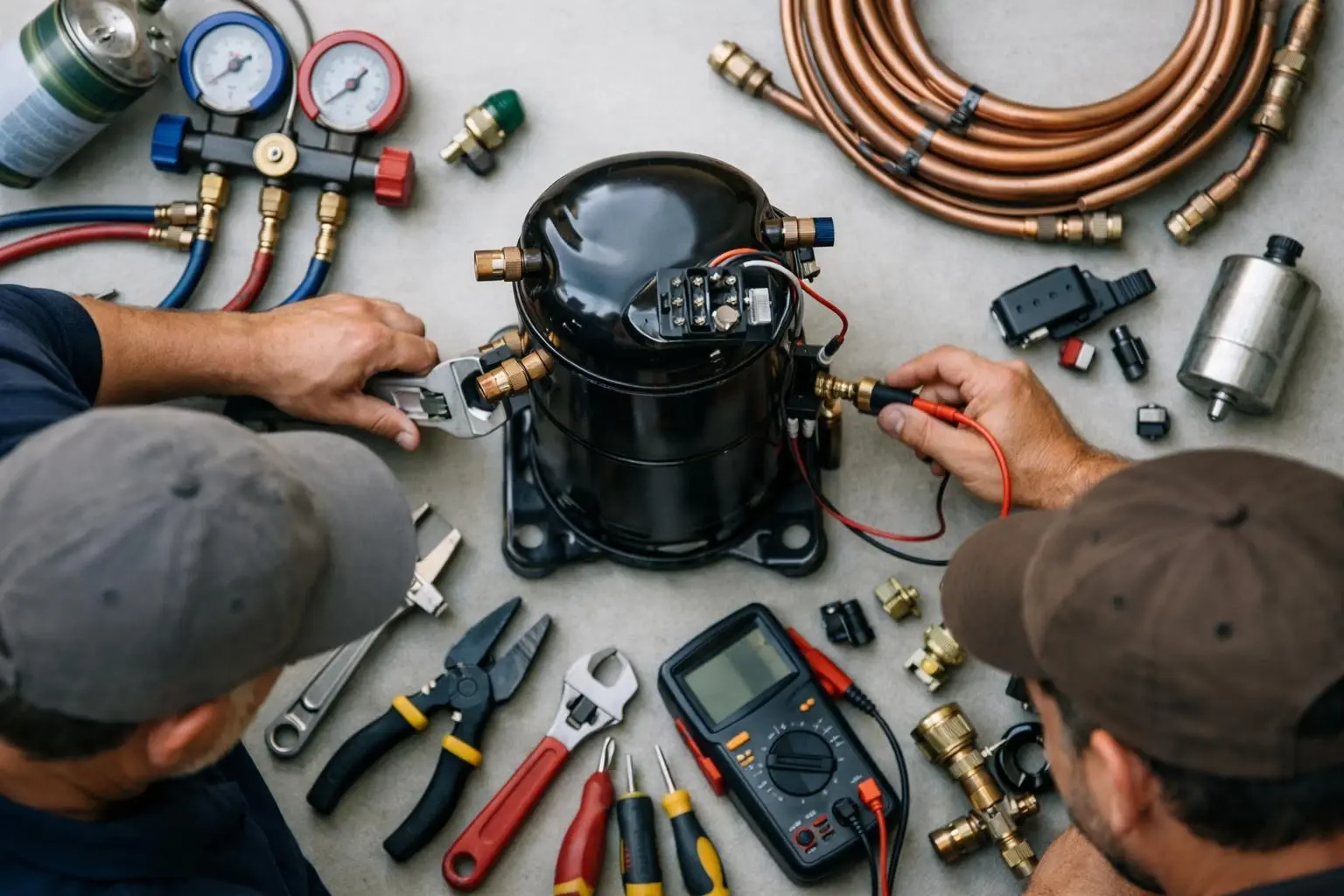
Compressor is the most critical and expensive part of any air-conditioning system. Without compressor, refrigerant cannot circulate, heat cannot be moved. And the home cannot be cooled or heated. Because compressor is sealed and contains moving parts lubricated by refrigerant oil, it's also one of the most vulnerable components. A failing compressor can lead to poor cooling, higher electricity bills. Or complete system breakdown.
Compressor efficiency directly affects energy bills. A worn or improperly sized compressor uses more electricity to move the same amount of heat, increasing monthly costs. Modern compressors are often two-stage or variable-speed designs that adjust their output to match cooling demand, saving energy and reducing wear. Proper installation, refrigerant charge. And regular maintenance help compressor last 10 to 15 years in most climates.
When Compressor Matters Most?
Compressor health becomes critical during peak cooling seasons, especially in hot climates like Lewisville, TX, where summer temperatures routinely exceed 95 °F. At these temperatures, compressor works harder and longer, increasing the risk of overheating or electrical failure. Homeowners should pay attention to compressor performance when the system struggles to cool, makes unusual noises. Or cycles on and off frequently.
Compressor also matters when buying a new air-conditioning system or replacing an old one. Choosing the right compressor size and type affects comfort, efficiency. And long-term costs. An oversized compressor cycles on and off too quickly, reducing efficiency and increasing wear. The result matters. An undersized compressor runs continuously, struggling to cool the home on hot days. Professional HVAC contractors perform load calculations to match compressor capacity to the home’s cooling needs, ensuring optimal performance and energy savings.
- During extreme heat waves, when compressor runs nearly nonstop.
- When energy bills rise unexpectedly, signaling possible compressor inefficiency.
- Before purchasing a new HVAC system, to select the right compressor type and size.
- When the outdoor unit makes grinding, buzzing. Or clicking noises.
- If the system blows warm air or fails to cool at all.